
Wythe County Former Owner Sources
Wythe County land history sits in layers. The online Secure Remote Access cutoff has never been published, so treat the modern remote index and the historic microfilm catalog as two separate eras. The Library of Virginia holds the older material. Its general grantor and grantee indexes run through 1907, and the deed books reach back to county formation. One caution helps here. A plat or survey can prove that two older descriptions actually describe the same parcel.
| Source | Years It Covers | Where Held | What It Shows |
|---|---|---|---|
| Virginia SRA index | Current online span not stated | Circuit Court Clerk / COVERS | Recorded-party search if enabled |
| Deed books and general indexes | 1790-1907 index; books cataloged into 1903 | Library of Virginia and clerk | Earlier conveyances and party names |
| Survey records | 1790-1910 | LVA microfilm catalog | Calls, acreage, and land descriptions |
| Plat books | 1839-1966 | LVA and recorded clerk series | Subdivision, lot, and parcel context |
Start from the newest deed and the current legal description. Search SRA for a modern index result first. When the chain crosses out of the online period, shift to the matching historic index, book, or plat. Remember that catalog dates mark spans only. They do not promise that every image is online.
Wythe County Chain Backward
A backward chain tracks the prior owner named in each conveyance. Hold every step against the legal description. The grantor and grantee index names the parties. Yet only the deed text reveals which land moved, whether acreage shifted, and whether a plat or survey appears. Chains rarely stay tidy. Ownership can pass to a trustee, a corporation, or an estate. It can also land on an entry marked simply as et al.
- Find the current deed by the assessment owner as grantee.
- Read the grantor and copy the legal description and reference.
- Search that grantor as a grantee in an earlier period.
- Compare acreage, road calls, adjoining owners, and plat references.
- Continue in historic volumes when the remote index no longer reaches.
- Grantor
- The party who conveyed the recorded interest.
- Grantee
- The party who received the interest.
- Chain of title
- The linked sequence of conveyances tied to one legal description.
Wythe County Books Before Remote Search
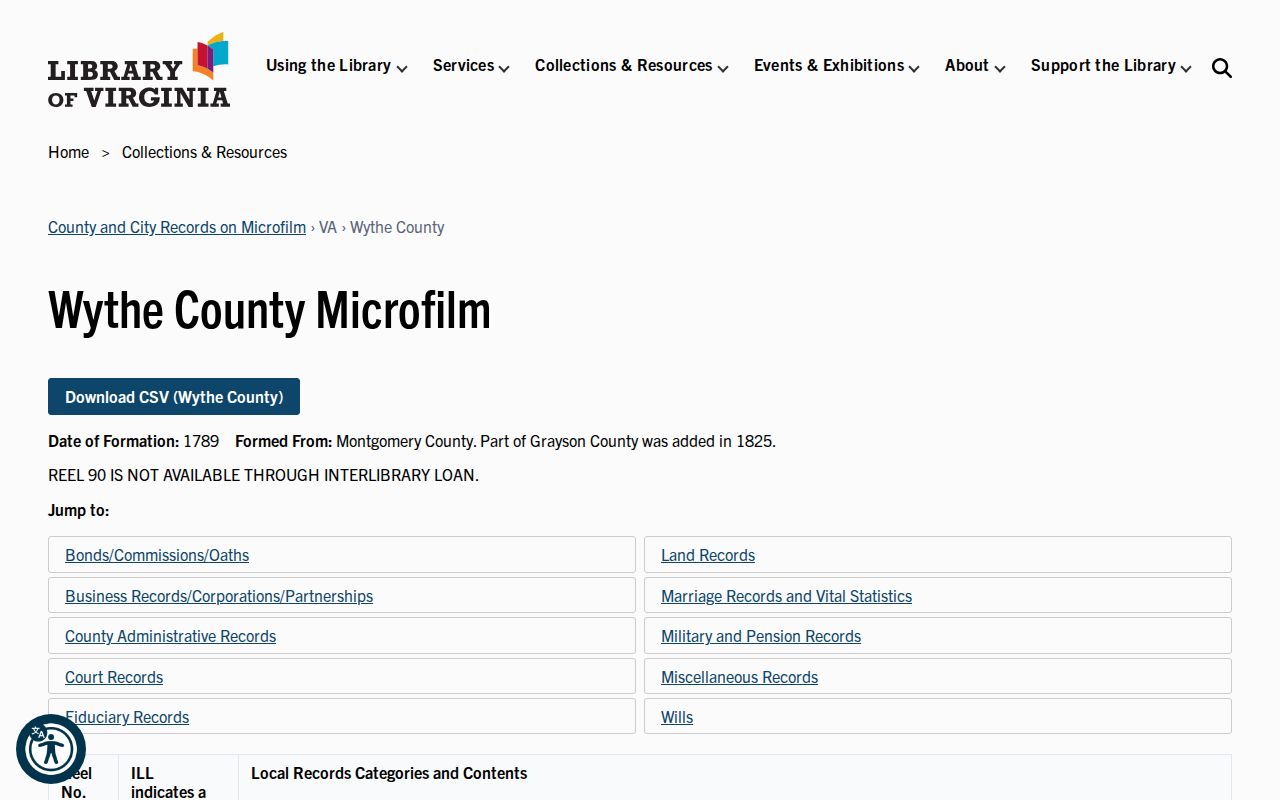
The historic finding aid draws several useful boundary lines for a backward search. Deed Books 1 through 21 span 1790 to 1860. Later deed reels continue into 1903, and the general grantor and grantee indexes reach 1907. The deed-of-trust sequence starts in 1891. Release deed books run through 1919. Pick each series by its likely instrument and date. Do not treat everything as one continuous online database.
A chain will eventually hit the edge of an index. Write down the last known grantor, grantee, year, book, and page. Then work out which reel group covers the earlier period and search the correct party index. Deeds often cite a parent tract, an earlier survey, a road, or adjoining owners. Compare those details with the present tax map before joining two similarly named properties. Ask about access notes too, because some reels are not available through every loan route.
The Library of Virginia catalogs Deed Books 1 through 21 from 1790 to 1860. Later book reels are listed through 1903. One reel group holds the general grantor indexes covering 1790 to 1907. A second group holds the grantee indexes for the same span. Search the correct side and watch for spelling variants. Move from the index entry to the book and page. Some later reels are marked unavailable for interlibrary loan. Read the catalog's access note before planning a visit or request.
Wythe County's emergency plan keeps a copy of local real-estate records. That copy is held at the Archives and State Library in Richmond. It is a practical backup when a local image is unavailable. The Wythe finding aid shows the collection sequence.
When a remote result stops short of the prior owner, request the specific book or reel range instead.
Rebuild a Wythe County Ownership Chain
Build a transfer timeline as you go. For each link, note the date, the instrument type, and who conveyed to whom. Add the book and page or instrument number, plus the legal description. A Wythe County tax card may point to an old ownership reference or to related taxable parcels. Treat those entries as clues. Confirm each reference against the recorded deed book itself. Later splits, combinations, and corrected descriptions can all reshape the chain. That is why the 1997 assemblage note on a sample card matters: an earlier conveyance sometimes covered a much larger tract than today's parcel.
Names shift for many reasons. Marriage, estate administration, corporate amendments, and trustee changes all leave paper trails. Search spelling variants and the exact entity style printed in the instrument. Two people sharing a name are not automatically the same grantor. Compare middle initials, spouse or fiduciary references, adjoining land, and legal acreage before linking them. When an index row resists a confident match, ask the Clerk to help identify the right book or image. Do not force the connection.
Treat the current assessment owner as a lead, not an endpoint. One sample land card carries a Record of Ownership section with an older reference. It also carries an assemblage note. The same card lists several included taxable parcels. That means the prior conveyance may relate to a larger tract. It may also relate to a group of map IDs. Follow each included parcel and compare its deed description. One owner line does not always describe a single intact lot.
- Write down the card’s map number, related parcels, and ownership reference.
- Find the newest deed and compare its legal description.
- Search the named grantor as a grantee in the prior period.
- Follow any estate, trust, or company transfer by its legal name.
- Use plats and surveys when a number or address changed.
- Grantor / grantee
- The conveying party and the recipient named in a deed.
- Chain of title
- The recorded succession of interests in the parcel.
- Legal description
- The land text that ties an older deed to the present parcel.
Estate Transfers and Former Owners
Probate can interrupt a simple sale-to-sale chain of Wythe County ownership. A death record may establish identity when access rules allow it. Yet that record does not convey real estate by itself. For the actual transfer, search the Circuit Court Clerk for the will, the fiduciary file, or an executor deed. Commissioner deeds and distribution orders matter too. Then check the land records for heirs listed as grantees, and verify the legal description on any recorded deed before adding it to the chain.
Virginia sets firm access windows for vital records. Birth certificates become public after 100 years. Death, marriage, and divorce records open after 25 years under Va. Code §32.1-271. Earlier certificates generally carry eligibility and identification requirements.
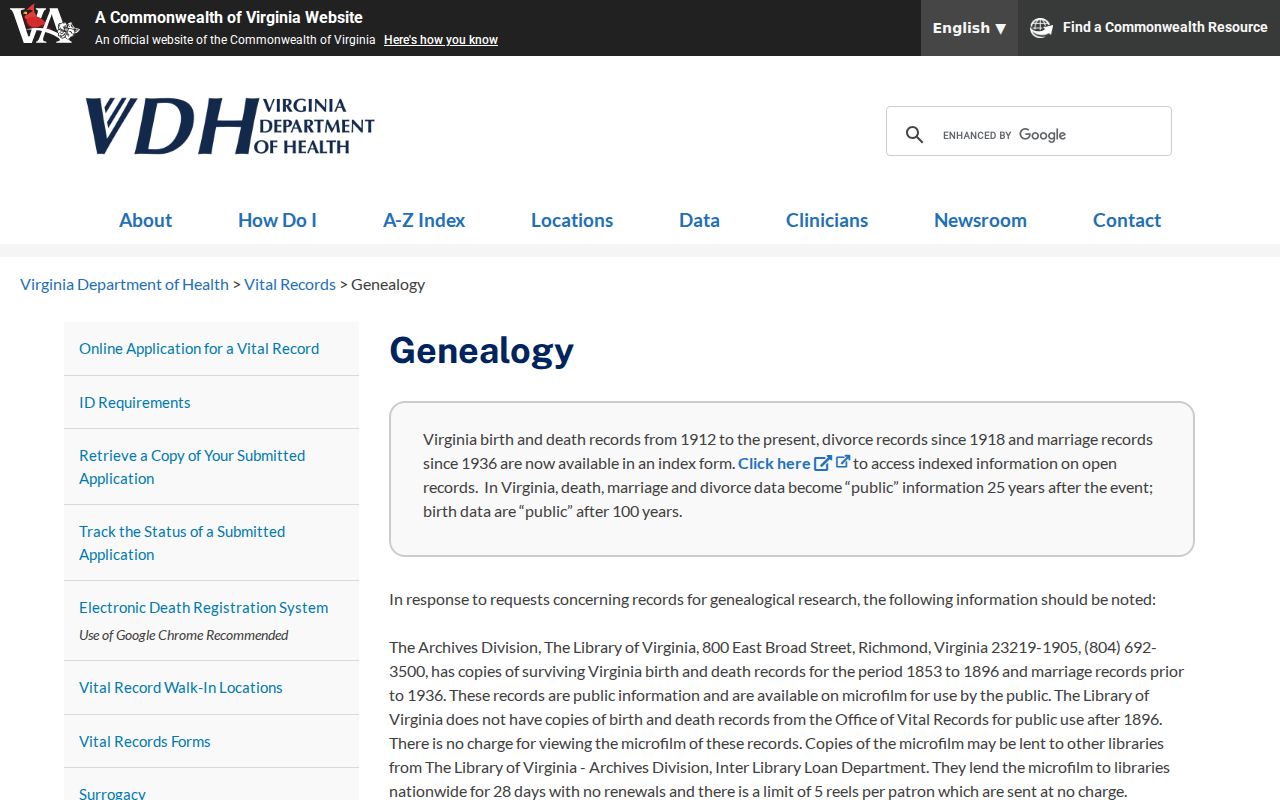
For older index routes, see Virginia Vital Records genealogy access. The state's Vital Records frequently asked questions page summarizes those public opening periods and the access rules that govern earlier certificates.
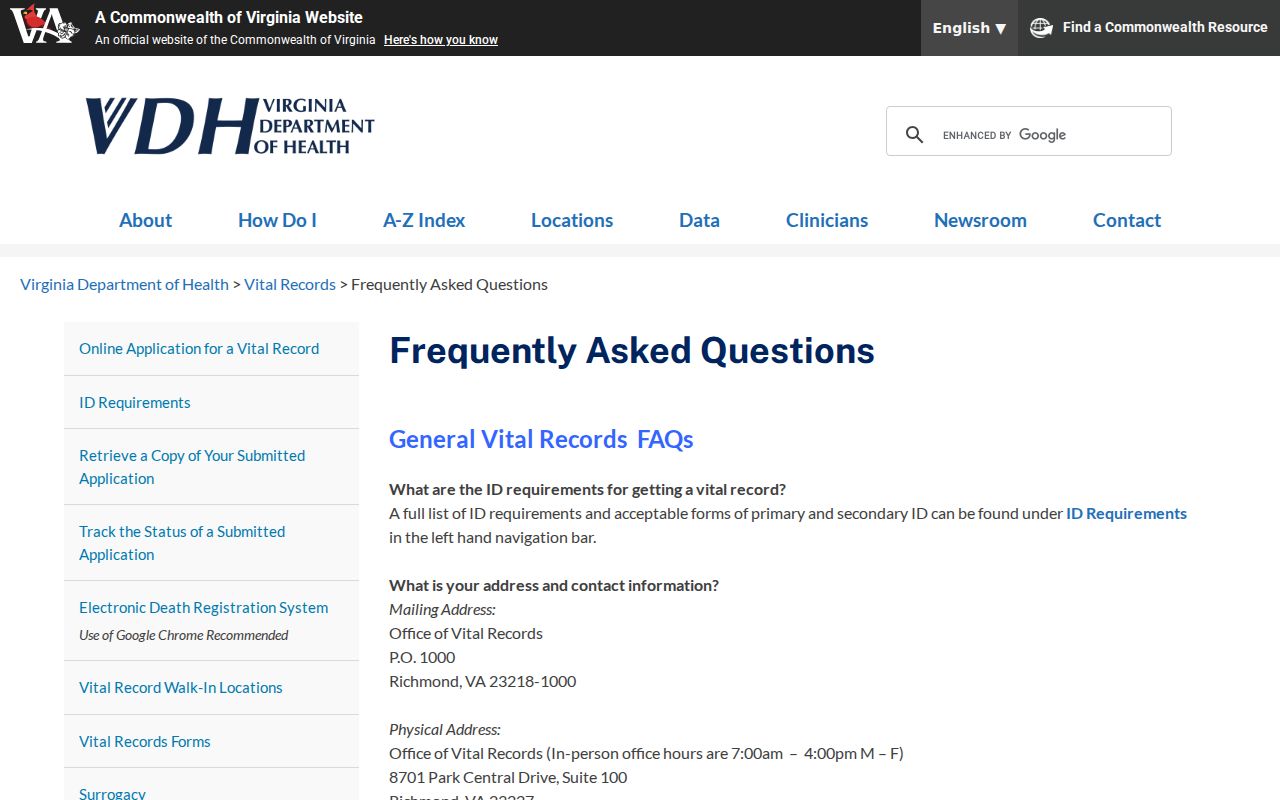
Those state access dates only pick the record route. Eligibility decides which certificates you can order. The VDH genealogy page describes historic index and microfilm routes for older Wythe County estate research, while the Clerk's deed or probate file still confirms the property transfer itself.
Vital records can support identity questions when someone qualifies to request them. For the property itself, the clerk's probate and deed files show how the estate transfer was handled.
How Far Wythe County Records Reach
An online chain rarely ends at the first owner. Wythe County's Deed Book 1 dates to 1790, when the county's recorded sequence begins. That book is not the start of ownership. A parcel history can connect to a Virginia land grant or to a predecessor record outside the modern county book series. Older deeds often cite earlier land. When they do, track the cited grant, survey, or adjoining tract rather than assuming the first deed book names the first owner. The Clerk and the Library of Virginia can identify the next historical collection.
Keep online reach in perspective. Searchable years may fall short of the oldest microfilm. The county posts no exact imaging cutoff, so check how far the online deed records actually reach before assuming full coverage back to 1790. Earlier ownership may need predecessor-jurisdiction or land-grant research.
Lawful use. Trace earlier owners for a property’s history, title review, boundary research, or estate work. Do not use former-owner information to stalk, harass, or harm any living person.